Lesson 1.9 - Compiling the screensaver
The screensaver project is done and saved. Time has come to compile it and create your first Windows® screensaver. This procedure will create a SCR file (see What is a screensaver for more info). You can set this screensaver as Windows® default or just save it in a specific location for redistribution. Compiling a screensaver is done in 6 steps:
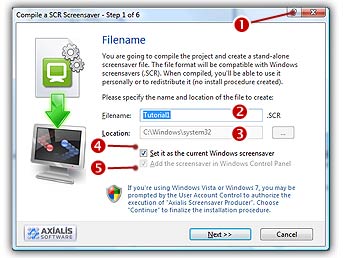
Step 1 of 6 - Filename
1. Choose Make Screensaver (F4). A dialog box opens (see below).
2. In the Filename field ( ), specify the name of the SCR file to create (do not specify the SCR extension). Keep the proposed name "Tutorial1".
3. Do not change the Location field ( ). It may be disabled. You can specify here the folder where you want to create the file. If you want to redistribute this SCR file, specify your output folder. If you want to use this screensaver on your computer only, do not modify the proposed entry (see below). In this tutorial, we'll set the screensaver as Windows® default. So, don't change this field.
4. Do not change the Add the screensaver in Windows Control Panel option ( ). This option is used to create the file in Windows system folder. In such a case, the screensaver will be visible in Windows® screensaver settings list (see What is a screensaver for more info).
5. Choose the Set it as the Current Windows Screensaver option ( ). The fields and are disabled because they're set by default when you choose to set your screensaver as default. When done, click Next.
Step 2 of 6 - Description
6. A new dialog box opens (see below). In the Title field ( ), keep the proposed title "Tutorial1". We always recommend you to keep the proposed title (which is the one you specified when you created the screensaver).
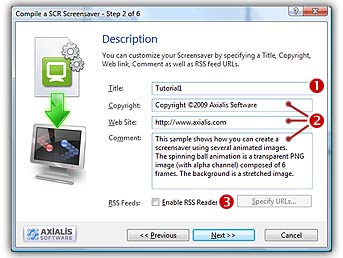
7. Specify your own data in Copyright, Web Site and Comment fields (). See context help [?] for more information on these fields.
8. Do not modify the RSS settings (). RSS is an advanced feature which is not part of this tutorial. See this topic to read more about this feature. When done, click Next.
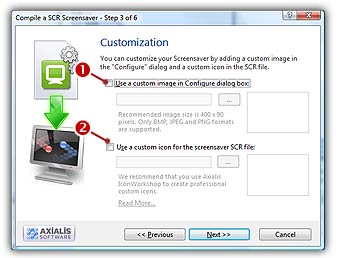
Step 3 of 6 - Customization
6. A new dialog box opens (see below). Do not modify the Customization settings. This dialog box is used to customize the icon () of the screensaver as well as the image () displayed in the configure dialog box. This is an advanced feature which is not part of this tutorial. See this topic to read more about this feature. When done, click Next.
Step 4 of 6 - Splash screen
7. A new dialog box opens (see below). A splash screen is a small window that will be displayed for short period of time before the Screensaver starts. This feature permits you to display the name of the screensaver, your name, a copyright notice or the logo of your company. See this topic to read more about this feature. In this tutorial, we choose to display a Text splash screen. It will display the name of the screensaver and the copyright notice (you specified in Step 2).
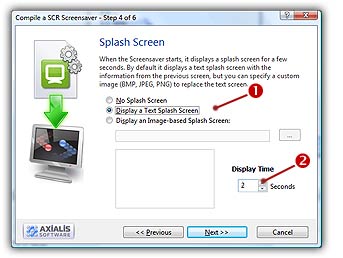
8. Choose the option Display a Text Splash Screen (). In the Display Time group (), specify 2 seconds. The splash screen will be displayed as text for 2 seconds. When done, click Next.
Step 5 of 6 - Preview window
9. A new dialog box opens (see below). You can specify here the kind of preview you wish for the screensaver. The preview window is displayed in the Windows Control Panel when (you change of screensaver). See What is a screensaver topic for more info (see "How to install a screensaver"). In this tutorial, we choose to display an Animated Preview of the screensaver. You'll see a real preview of the moving and colliding balls!
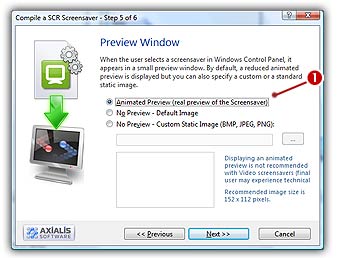
10. Choose the option Animated Preview (). When done, click Next.
Step 6 of 6 - Ready to go
11. A new dialog box opens (see below). This is the last screen before the compilation starts. Nothing to specify here. Just take a look at the compilation summary. If something is wrong, you can go back to the previous screens by clicking Previous button. Also, read the information about Copyright.
10. When done, click Next.
Compilation, tests
12. A dialog box opens in which you see the compilation in progress (a few seconds). If a problem occurs during the compilation, you see an error message.
If you work under Windows Vista or Windows 7, you'll be prompted by the Account User Control to authorize the application to install the screensaver file in Windows/System32 folder. This folder is protected so the access rights are temporary elevated to Administrator level to perform the operation. This elevation requires your authorization. Click Yes.
13. When done, the following screen is displayed.
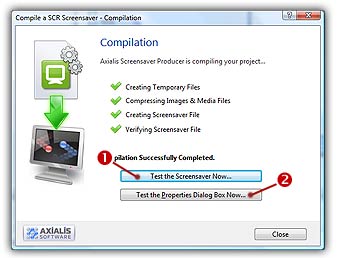
14. You can test the screensaver fullscreen now. Click on the Test the Screensaver Now button (). Do you like? This is YOUR screensaver now.
15. You can also test the screensaver Properties dialog box. See What is a screensaver topic for more info about the properties/configure dialog box (see "How to install a screensaver", button "Settings"). Click on the Test the Properties Dialog Box Now button ().
16. As you chose to install this screensaver as Windows® default (in Step 1), it will start automatically after a certain period of inactivity of your computer (depends on what you've configured in Windows® Control Panel). Click Close to finish.
Lesson 10 - Creating an install package